

We investigate the biodegradability of our papers.
Isn’t it a fabulous time of year? We have a hot summer on the horizon and Christmas is just over 8 weeks away. It’s the time of year that calls to us to get out in the garden, or down to the local beach or park and experience everything we love about a kiwi summer.
I had a reminder set on my calendar to head out to my strawberry patch on labour weekend, not to harvest (too early for that) but to excavate some paper samples I had buried approximately 12 weeks ago…
Sounds strange, I know! But sometimes we need to get our hands dirty to discover the truth about certain things; in this case, our very own paper stock.

Before I reveal my findings; I’d love to share some industry knowledge with you to better understand the eco-credibility of different photo papers.
Coated vs Uncoated paper stock.
Coated stocks are also known as Silk, Gloss or Satin finished papers. These papers have a smooth silky finish to them, they reflect light off the surface of the paper and allow for a brighter colour depiction in your photos. These fall into the RC (Resin Coated) category and make up the bulk of photo papers in use today. The resin is essentially a plastic coating that provides a low-cost way to create a smooth finish or ‘sheen’ required for photo paper.
The resin component in these papers is of petrochemical origin, and therefore while the paper may be from sustainable sources; the coating is not – and so it has a much higher impact on the environment. Further to this; these are not able to be recycled, and so cannot be part of a recyclable pulp/paper chain.
Uncoated stocks are matte paper stocks that have a natural finish with no extra coatings. They do not bounce light off the surface; they absorb it. This allows for rich tones and a more natural look to your photo prints. The more natural process of uncoated paper production and the natural ability to break down makes this paper less impactful on the environment and a better environmental choice.
Overall, RC papers have a higher environmental impact than non-RC papers.
Is sustainability front of mind?
Cotton
If you’re likely to prioritise sustainability when selecting a paper option, then you cannot beat Hahnemuhle Cotton Rag & Hahnemuhle Cotton White. These 100% cotton papers meet exceptional environmental standards (for even more detail click here.) Cotton is grown primarily for the textile industry, the cotton seeds, a by-product of the textile-producing process, are the source of the cotton linters that go to make cotton paper. Cotton paper can therefore be considered of very low environmental impact as no cotton is grown specifically to make paper. If the cotton paper were not made, the linters would be a wasted by-product.
Recycled
For exceptional environmental sustainability with fibre papers – the key is to look not only at the recycled component (produced with 30%+ post-consumer recycled content) but also that the remaining wood pulp is sourced from FSC-certified sustainable sources and no Resin Components are added to the paper. Out Photo Matte 180gsm stock delivers a 4-star eco rating and is both FSC and PEFC-certified.
So let’s investigate the remnants of what was brought to the surface after 12 weeks in a composted garden bed…!
Paper 1: Photo Matte (180 gsm)
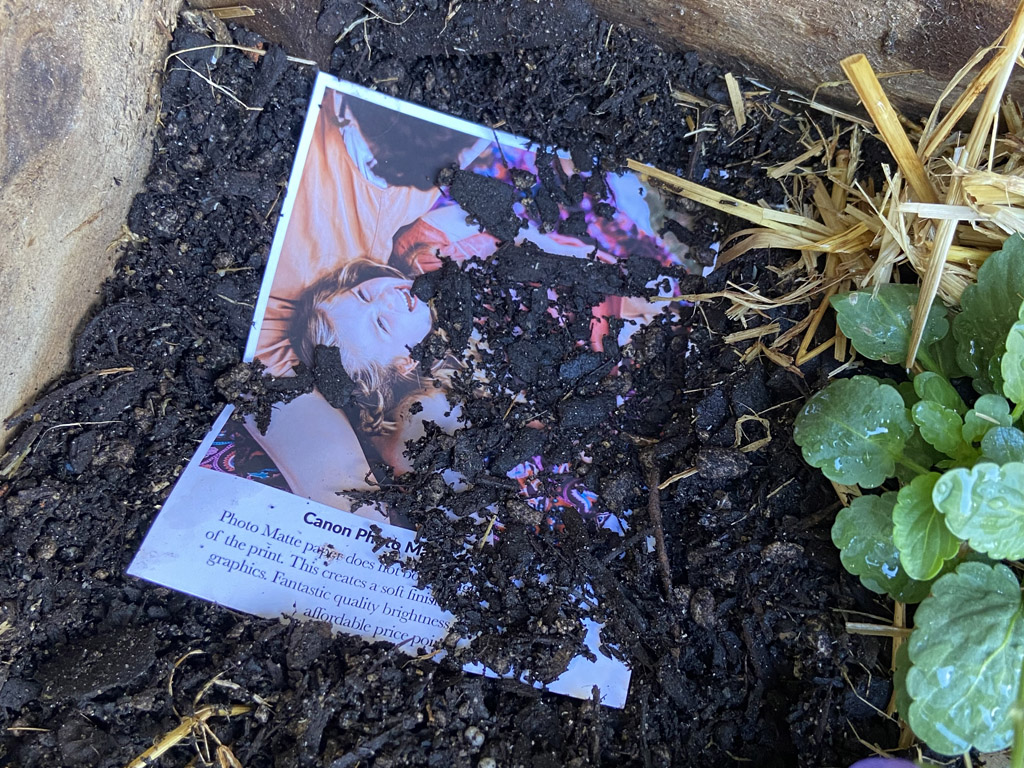

Paper 1 findings: Much to my amazement; there was absolutely nothing left to photograph. Clearly, this paper must have fully broken-down weeks ago as there were no remnants of this sample card.
(Photo Matte Paper Specifications)
Paper 2: Archival Silk (260gsm)


Paper 2 findings: You can see the paper splitting into two films, both sides of this sample card feel slightly more like plastic, as if the paper components within the sample broke down and have left the inorganic aspects of the film intact. The ink is still surprisingly vivid (Archival Silk is printed with a higher ink ratio to meet Archival standards) There is a hint of mould growth on the back of the sample.
(Archival Silk Specifications)
Paper 3 & 4: Hahnemuhle Cotton Rag (308gsm) and Hahnemuhle Cotton White (188gsm)


Paper 3 & 4 findings: As with Photo Matte; there was absolutely nothing left to photograph. The natural cotton fibres were easily broken-down weeks ago and there were no remnants of either of these sample cards.
(Hahnemuhle Cotton White & Hahnemuhle Photo Rag)
Paper 5: Pro Satin (240gsm)


Paper 5 findings: Similar to the other coated stock, Pro satin is also splitting into two thin sheets. It’s clear to see this paper has a higher synthetic component than Archival silk; as it has retained even more of its rigidity. The print has faded more than Archival silk, (Pro Satin is printed to non-archival ink standards) This also shows minimal mould growth and verifies the presumption of a higher synthetic component in this paper stock.
(Pro Satin Specifications)
Summary
Usually, we test the lifespan, quality and endurance of our papers; but in this instance, it was interesting to look at it from a different point of view. The winners were the ones who disappeared without a trace, and that includes leaving nothing behind even when they were produced. The coated stocks are designed to be tougher, longer lasting and more durable; but the tradeoff is making use of less environmentally sustainable processes and leaving more waste behind.
It’s great to see our matte stocks biodegrade so efficiently, and until the paper industry can generate more eco-friendly coatings for paper; we’ll have to accept that uncoated stocks remain the best shopping choice when sustainability is front of mind. If you, like many of our customers lean heavily towards eco-conscientious choices, then I hope you found this blog a helpful and insightful tool to better understand the world of paper.
All HappyMoose papers are certified by the Forest Stewardship Council (FSC).